Finding out that you have a kidney stone can immediately raise an important question: “Do I really need surgery?” Not every kidney stone requires a surgical procedure. The right treatment depends on factors such as the stone’s size and location, whether it is causing pain or blocking urine flow, and whether there are associated problems such as infection or recurrent symptoms.
Some kidney stones may pass naturally, while others may require a urologist to evaluate whether a minimally invasive procedure would provide a safer and more effective solution. Understanding these warning signs can help you seek timely medical attention instead of waiting for symptoms to become more difficult to manage.
When Does a Kidney Stone Need Surgical Treatment?
A kidney stone may need procedural treatment when it is difficult to pass naturally, causes persistent or severe symptoms, blocks normal urine flow, or is associated with complications.
The symptoms that should not be ignored include severe pain in the back or side, pain that may extend towards the lower abdomen or groin, blood in the urine, burning during urination, frequent urination, nausea or vomiting, and fever when an infection is present.
A stone that becomes large or obstructs the urinary tract may require prompt evaluation. Repeated urinary infections or recurring kidney-stone symptoms are also reasons to consult a urologist rather than continuing to wait for the stone to pass.
However, symptoms alone cannot determine whether surgery is necessary. A proper evaluation is important before deciding on treatment.
How Does a Urologist Decide Whether Surgery Is Necessary?
The first step is understanding the location and characteristics of the stone. A urologist may review your symptoms and medical history and recommend appropriate investigations to determine the stone’s size, position and effect on the urinary system.
Imaging such as an ultrasound, CT scan or X-ray may be used to identify the stone and assess the urinary tract. Urine tests can help identify blood, infection or other abnormalities, while blood tests may help evaluate kidney function and related factors.
This information allows the urologist to determine whether observation, medical management or a procedure is more appropriate.
That is why two people with kidney stones may not necessarily receive the same treatment. The treatment plan should be based on the individual condition rather than simply the fact that a stone is present.
What Are the Signs You Should See a Urologist?
You should consider consulting a urologist if you experience persistent or severe flank or back pain, blood in the urine, difficulty passing urine, repeated urinary infections or symptoms that continue to return.
Severe pain accompanied by nausea, vomiting, fever or chills requires timely medical attention because these symptoms may indicate obstruction or infection.
Even when the pain improves, a medical evaluation can be important if a kidney stone has already been identified. A reduction in pain does not by itself explain whether the stone has passed or whether further treatment is required.
Early assessment can help identify the condition and allow the urologist to select an appropriate treatment approach.
What Kidney Stone Surgery Options Are Available?
Treatment is not limited to one type of procedure. Depending on the stone and the patient’s condition, different minimally invasive approaches may be considered.
RIRS for Kidney Stones
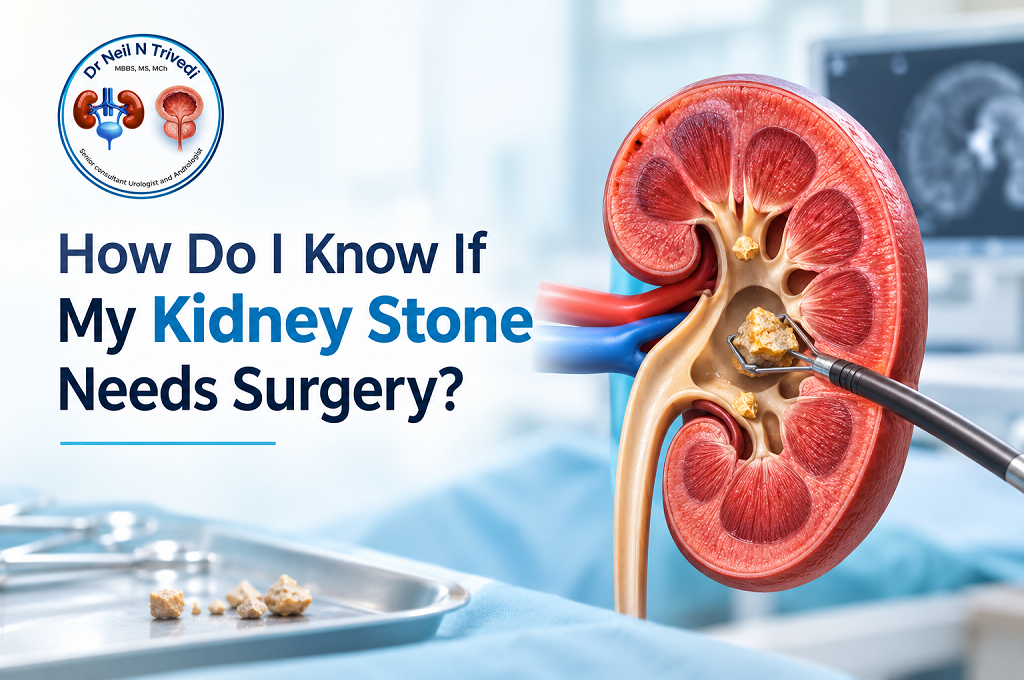
Retrograde Intrarenal Surgery (RIRS) is a minimally invasive procedure used to treat stones located inside the kidney. A flexible ureteroscope is passed through the natural urinary passage to reach the kidney. The stone can then be fragmented using laser energy, with the smaller fragments either removed or allowed to pass naturally.
RIRS can be considered for kidney stones that are difficult to pass naturally or are not suitable for other treatment approaches.
URSL and Laser URSL
Ureteroscopic Lithotripsy (URSL) is used for stones located in the ureter. A thin ureteroscope allows the urologist to directly visualize the stone, while laser technology can be used to fragment it.
This minimally invasive approach does not require an external surgical incision and may allow a faster recovery compared with traditional surgical approaches.
PCNL
Percutaneous Nephrolithotomy (PCNL) is another kidney-stone treatment available through advanced endourological care. It may be considered for larger kidney stones, with the final treatment decision depending on the individual patient’s condition, stone characteristics and overall health.
Dr. Neil N. Trivedi provides RIRS, URSL, Laser URSL and PCNL as part of his advanced endourological services in Secunderabad.
Does Every Kidney Stone Require Surgery?
No. The presence of a kidney stone does not automatically mean that surgery is necessary.
Some stones may be managed without a procedure, while others may require active treatment because they are difficult to pass, cause significant symptoms, obstruct urine flow or are associated with infection or recurrent problems.
The important point is to avoid deciding treatment based only on pain intensity. A proper urological assessment can help determine what is actually happening and which treatment is appropriate.
Why Choosing the Right Urologist Matters
Kidney-stone treatment requires more than simply removing the stone. The urologist needs to assess the stone, understand its location and characteristics, identify possible complications and select an appropriate treatment approach.
Dr. Neil N. Trivedi is a urologist and endourologist with more than two decades of clinical experience. His expertise includes minimally invasive kidney-stone procedures such as RIRS, URSL, Laser URSL and PCNL, along with DJ stenting and other endourological interventions.
His website also highlights experience with complex kidney-stone management, including a rare anatrophic nephrolithotomy procedure for an 8 cm kidney stone.
For patients searching for the best urologist in Secunderabad for kidney-stone evaluation and treatment, the priority should be finding a specialist who can assess the individual condition and explain the available treatment options clearly.
Looking for Kidney Stone Treatment in Secunderabad?
If you have persistent kidney-stone pain, blood in the urine, difficulty passing urine, recurrent urinary infections or other symptoms associated with kidney stones, do not ignore them.
A timely consultation with an experienced urologist can help determine whether the stone can be managed conservatively or whether a minimally invasive procedure such as RIRS, URSL or PCNL may be appropriate.
Dr. Neil N. Trivedi provides advanced urological and endourological care in Secunderabad, including evaluation and treatment of kidney stones. If you are searching for a best urologist near me in Secunderabad or need kidney stone treatment in Secunderabad, professional evaluation can help you understand the right next step for your condition.
Frequently Asked Questions
1. How do I know if my kidney stone needs surgery?
A kidney stone may require a procedure when it is difficult to pass naturally, causes persistent or severe symptoms, obstructs urine flow, or is associated with infection or recurrent urinary problems. A urologist can determine the appropriate treatment after evaluating the stone and the patient’s condition.
2. What symptoms should make me see a urologist for a kidney stone?
Severe or persistent flank pain, blood in the urine, difficulty passing urine, repeated urinary infections, nausea, vomiting, fever or chills should not be ignored. These symptoms may require timely medical evaluation.
3. What is RIRS kidney stone treatment?
RIRS, or Retrograde Intrarenal Surgery, is a minimally invasive procedure used to treat kidney stones. A flexible ureteroscope is passed through the natural urinary passage into the kidney, where the stone can be fragmented using laser energy.
4. Is URSL used for kidney stones?
URSL is a minimally invasive procedure used to treat urinary stones, particularly stones located in the ureter. A ureteroscope is used to visualize the stone and laser technology can be used to break it into smaller fragments.
5. Where can I consult a urologist for kidney stone treatment in Secunderabad?
Dr. Neil N. Trivedi provides urological and endourological care in Secunderabad, including kidney-stone evaluation and procedures such as RIRS, URSL, Laser URSL and PCNL. Patients can consult the specialist to understand whether their kidney stone requires active treatment and which approach may be appropriate.